
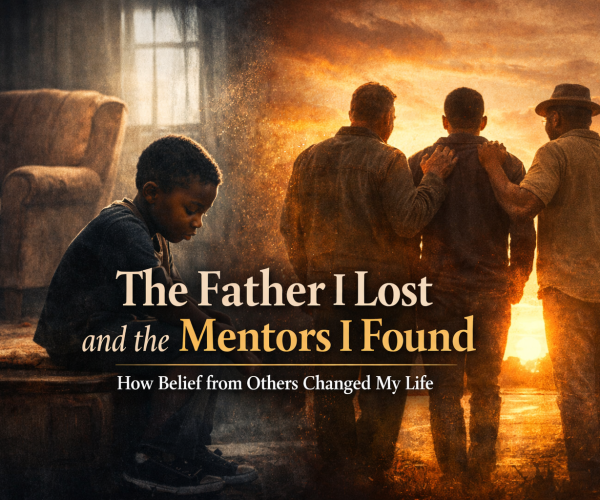
I was seven years old when my father died.
He was thirty-two.
At seven, you don’t understand death.
All I knew was that the seat he sat in every evening remained empty.
We did not wrestle before bed anymore.
We did not play chess.
We did not go to soccer games on weekends.
That deep voice that put me in line just by hearing it, the one that used to fill the house, was gone. Disappeared like the shadow I followed.
The man I thought would always be there was no longer there.
My mother was loving. She was strong. She provided.
But she could not be both mother and father.
A quiet search marked the years that followed. I was looking for a father figure even when I did not have the language to describe the void inside me.
Like a tourist without a guide in a foreign land, I wandered into adolescence struggling to navigate a world I had slowly entered. A world of raging hormones speaking a demanding foreign language, my youthful body understood too well. A world of identity crisis and the craving to belong.
In adolescence, that search became louder.
I found boys who seemed confident. Boys who seemed bold. I followed some of them down paths that, if continued, would have landed me in places where I would not be sitting here writing this.
I would not be alive to tell this story.
Whether you call it luck or divine intervention, a man entered my life when I was fourteen. I called him Mr. Chif, a man in his mid-thirties.
Mr. Chif took me under his wing.
We called it discipleship. It shares its root with discipline. In church circles, it means being a student.
For four years, my mentor, Mr. Chif, discipled me.
He taught me about integrity. He taught me about leadership, not in a corporate boardroom sense, but in a volunteer sense.
Leadership as service. Leadership as character. Servant leadership.
He handed me my first John Maxwell book, Developing the Leader Within You. I devoured that book. The only book I read at the time was the Bible, which I had read from cover to cover many times. Why? Because it was the only book I had.
I do not know what he saw in me. I had nothing that screamed leader.
I was timid.
I lacked confidence.
I carried low self-esteem like a hidden wound.
My father’s death not only took away my father. It took away my self-worth. The kind that comes from a father’s validation.
I carried limiting beliefs like heavy stones in my pockets.
No one had told me they believed in me until I met that man. Even then, it took a while to stop believing I wasn’t good enough.
Mr. Chif was not a decorated man with accolades and prestige. He is a simple teacher and a principal. He has given his life to caring for orphans. He still does.
His life was not loud.
It was steady.
That steadiness and humility changed me.
At eighteen, another mentor entered my life.
He was an engineer with a PhD in civil engineering from the University of Missouri. He had built bridges and highways across St. Louis and the Midwest.
Mr. George, whom I called Uncle George. He and his wife took me in.
“There is no reason you will not be successful if you follow what I tell you to do,” he said.
The first time we spoke seriously about my future, he said, “You need to study engineering.”
I told him I liked helping people. I wanted to study something that would help people.
He chuckled. “Helping people?”
“There are enough people helping people who are struggling to help themselves. Study STEM. Figure out how you will help people once you become an engineer.”
He encouraged me to apply to the University of Missouri-Rolla. I had no clue where it was, but he drove me there before I applied. He walked me through the campus as he relived his memories.
As we walked through Rolla, he said, “I remember washing cars to take care of my family of four while doing my PhD here. Customers tipped the white guy by handing him dollar bills. They threw quarters at me like I was a dog. It bothered me. But I did it every day. Back then, it was bad. Things have changed. Today, I have twelve of them that work for me.”
I stared at him. I knew what he meant. He didn’t have to explain further.
“Because I am that good,” he said and smiled.
I felt proud of him. I wanted to be that good.
“Never use racism as an excuse. You have to work harder than anyone. Be the best you can be. If I can do it, you can do it.”
It did not take much convincing. I saw how he lived.
The discipline. The stability. The confidence.
I wanted that for myself.
One weekend, he took me fishing to Rathbun Lake in Iowa. On the way, he played Jim Rohn’s lectures in the car. Being in Uncle George’s vehicle felt like being in a masterclass. You did not sit in that car for long and leave it the same. It felt like a temple. Your mind was rewired.
“If you want to be successful, you have to listen to successful people,” he said.
The lecture was titled The Day That Turns Your Life Around.
“Do you have any books by him?” I asked.
“I have several. Remind me when we get home.”
At the marina, we met Mr. Mwamba, Uncle George’s friend.
I occured to me that we were the only black people there, surrounded by a myriad of people.
The patrons around the marina walked with an air of sophistication and success. They puffed on cigars and popped champagne.
Mr. Mwamba introduced two middled aged white men to us.
“This is Tom, and this is Chris. They are my business partners. We own this place together,” Mr. Mwamba said.
I gaped.
Mr. Mwamba turned to us and said, “Tom, Chris, this is my family. This is my brother, Dr. George, from St. Louis.”
We shook hands with the businessmen at the marina before hobnobbing with them the rest of the day on Uncle Mwamba’s patio, which sat in the water of the lake, giving us a breathtaking view of the lake festooned with speedboats, water rafts, kayaks, jet skis, and gorgeous white sand beaches in the distance.
Seeing one of my own in that light did something to me.
It reinforced what Uncle Mwala had told me. I could achieve anything.
We rode jet skis. Played volleyball. Stayed in his lakeside home.
Education, I realized, could change a man’s life.
On the drive back to St. Louis, Uncle George played Les Brown. Les spoke about being hungry. His energy mesmerized me.
That weekend changed me.
Uncle George lit a fire in my life.
When we got home, he handed me a signed copy of Live Your Dreams by Les Brown.
“Read, son. Read everything. Fools will not read. There is a reason slaves were prevented from reading. Knowledge is power. Ignorance will cost you. Learn from others’ mistakes. Why burn yourself to learn that fire is hot when you can learn from someone else?”
He introduced me to Jim Rohn, Tony Robbins, Brian Tracy, Zig Ziglar, Napoleon Hill, and Earl Nightingale.
He gave me a roadmap for winning in America.
At last, I found the father figure I had searched for.
A mentor. A friend. A fan who believed in me.
I wanted to make him proud.
At eighteen, my personal development journey began in earnest.
Jim Rohn taught me that you are paid for value, not time. That your income is determined by how valuable you choose to become.
That idea rewired me.
I followed his guidance.
I graduated with my bachelor’s degree.
I was happy.
But I was grieving.
My mentor did not attend my graduation. He died the year before from lymphoma. He was fifty-one.
There are some debts you can never repay.
The reason I am an engineer.
The reason I manage people.
The reason I impact lives.
Someone believed in me.
Years later, another mentor, Clement, a successful businessman, told me to negotiate a job offer higher than I thought I deserved.
“They are offering $80,000. What do you think, Clem?”
“I think that’s not enough.”
“What if they rescind the offer?”
“Ask them for at least $95,000.”
“That’s too much, Clem.”
“It’s not. You are worth it,” he replied.
I asked for more.
They agreed.
I often wonder what would have happened if I had not had him in my corner.
In my career, I have continued to seek mentors. Even today, I meet with mentors regularly. I still sit as a student.
Mentors can change your life.
They can redirect your trajectory.
They can refine your gifts rather than let them go to waste.
And sometimes the difference between becoming who you were meant to be and disappearing into the noise of the world is simply this.
Did someone believe in you long enough for you to believe in yourself?