
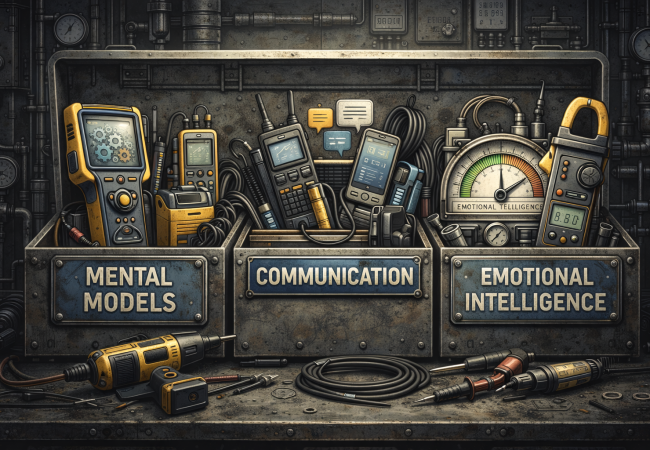
I didn’t set out to become a leader. I didn’t wake up one day with a vision statement or a five-year plan. I was called into my boss’s boss’s office, given a choice, and handed a team the following Monday. What came next was confusion, self-doubt, and a kind of learning you don’t get from books or titles. This is a reflection on where I started, what I got wrong, and the tools I had to learn the hard way while moving from the comfort of technical work into the uncertainty of leading people.
I remember being called into my boss’s boss’s office over a decade ago. What they called a “manager once removed.”
He asked me,
“Ajay, there are two paths you can take in your career. You can manage people, or you can remain on the technical side. What do you want to do?”
I looked at him and said, “Managing people.”
He nodded.
“Okay then. You have a team on Monday.”
That’s how my leadership journey started.
I had no clue what I had just signed up for.
When Monday came, I was supervising fifteen electricians who had more field experience than I did. I felt like an imposter. I wanted to quit.
I had been an electrical and controls engineer, programming HMIs, troubleshooting network issues, and managing projects of different complexities. Now I was managing people. Before that role, I had tools. Workstations. Meters. The familiar instruments of the electrical trade. I knew where to put my hands. I knew what to check when something failed.
In this new role, I didn’t even know what tools I needed. The only thing I knew was that I would be telling people what to do.
I didn’t know anything about motivating, coaching, influencing, inspiring, or appraising performance. I didn’t yet understand that troubleshooting didn’t end in the field. It simply changed shape. I now had to troubleshoot people issues. Conversations. Tension. Silence. Resistance. Fear. Pride.
I had never led before, outside of volunteering. But volunteer leadership is different. In those spaces, outcomes are usually aligned. People are there because they want to be. Organizational health issues don’t surface the same way they do at work, where paychecks, pressure, and identity are involved.
Looking back on over a decade of learning how to lead, I’ve learned this. Leadership is a skill like any other skill. It must be learned. Competence comes through practice, the same way it does with swimming or playing the piano. No one is born knowing how to do this.
People may have natural gifts that give them an edge, but leadership itself is built.
If I were advising my younger self, I’d tell him to learn these tools early. It would have saved me years.
Just like it’s hard to be an effective electrician without a meter or cutting tools, it’s hard to be an effective leader without the right ones.
These are the tools I wish someone had told me I needed when I began my leadership journey.
1. Mental models
These are cheat codes.
As a kid playing Mortal Kombat, if you knew the right sequence, the fight ended fast. Mental models work the same way. They help you think in structured ways when situations are messy and unclear. The more mental models you have, the better your decisions tend to be.
Different situations call for different models. Leaders who develop this skill think differently. Not because they are smarter, but because they have better thinking tools.
2. Communication
Communication starts with the senses. Your eyes. Your ears. Your awareness.
When words and body language don’t align, people tend to trust posture, facial expression, and tone over what’s being said. In leadership, that matters.
You learn to read rooms. Tone shifts. Folded arms. Silence that lingers a little too long. Especially when things are tense. But reading people only works if you’re also listening.
Not listening to respond. Listening to understand.
Sometimes the most effective thing a leader can say is,
“Help me understand.”
What I typically do to show someone that I’m listening is repeat back what I hear. I’ll say,
“John, what I hear you saying is that you’re not pleased with how this was handled. Is that right?”
Then I stop talking.
I let them confirm it or correct me. That moment alone has prevented more damage than any policy ever could.
3. Emotional intelligence
As a leader, the ability to be emotionally in tune with people matters.
Emotional intelligence can be developed like any other skill. Leaders who cultivate it get to the heart of issues faster. They sense when a problem isn’t really about the work. They don’t avoid hard conversations, but they approach them with awareness and restraint.
These aren’t the only tools out there. But over the last decade, these have been the most effective for me.
If you want to go deeper, a few resources that shaped how I think about these tools:
- Super Thinking by Gabriel Weinberg and Lauren McCann
- Crucial Conversations by Kerry Patterson, Joseph Grenny, Ron McMillan, and Al Switzler
- Emotional Intelligence by Daniel Goleman
Leadership isn’t discovered.
It’s built.